

For most of his career, Dr. Marcos Vieira had lived with the quiet conviction that the Amazon did not want to be understood. It tolerated human presence the way an elephant tolerated a fly: with patience, but without fondness. Even after decades of fieldwork, there were places he wouldn’t step into, valleys he wouldn’t map, rivers he wouldn’t cross. Some things stayed untouched for good reason.
But the satellite images demanded an exception.
At 7:14 a.m., an intern rushed into his office, laptop in hand, eyes wide. “Sir, you have to see this,” she said.
The images showed a familiar patch of green, a square of untouched canopy he’d studied before. But in the next pass—just ninety minutes later—the square was split clean open, exposing a structure so geometrically perfect that no natural formation could explain it.
A temple, emerging from beneath the forest like a stone held underwater for centuries.
No deforestation.
No bulldozer tracks.
No logging scars.
The jungle had simply… opened.
And something else appeared too—an odd, faint discoloration spreading outward from the structure, like bruising on the skin of the forest.
By dawn the next morning, Marcos and a six-person expedition team were helicoptering over the vast, trembling-green sea of the Amazon. As the aircraft dipped lower, even through the headset they could hear the frantic shrieking of cicadas—louder, higher, and far more numerous than normal.
The pilot swore. “They’re acting like something scared them.”
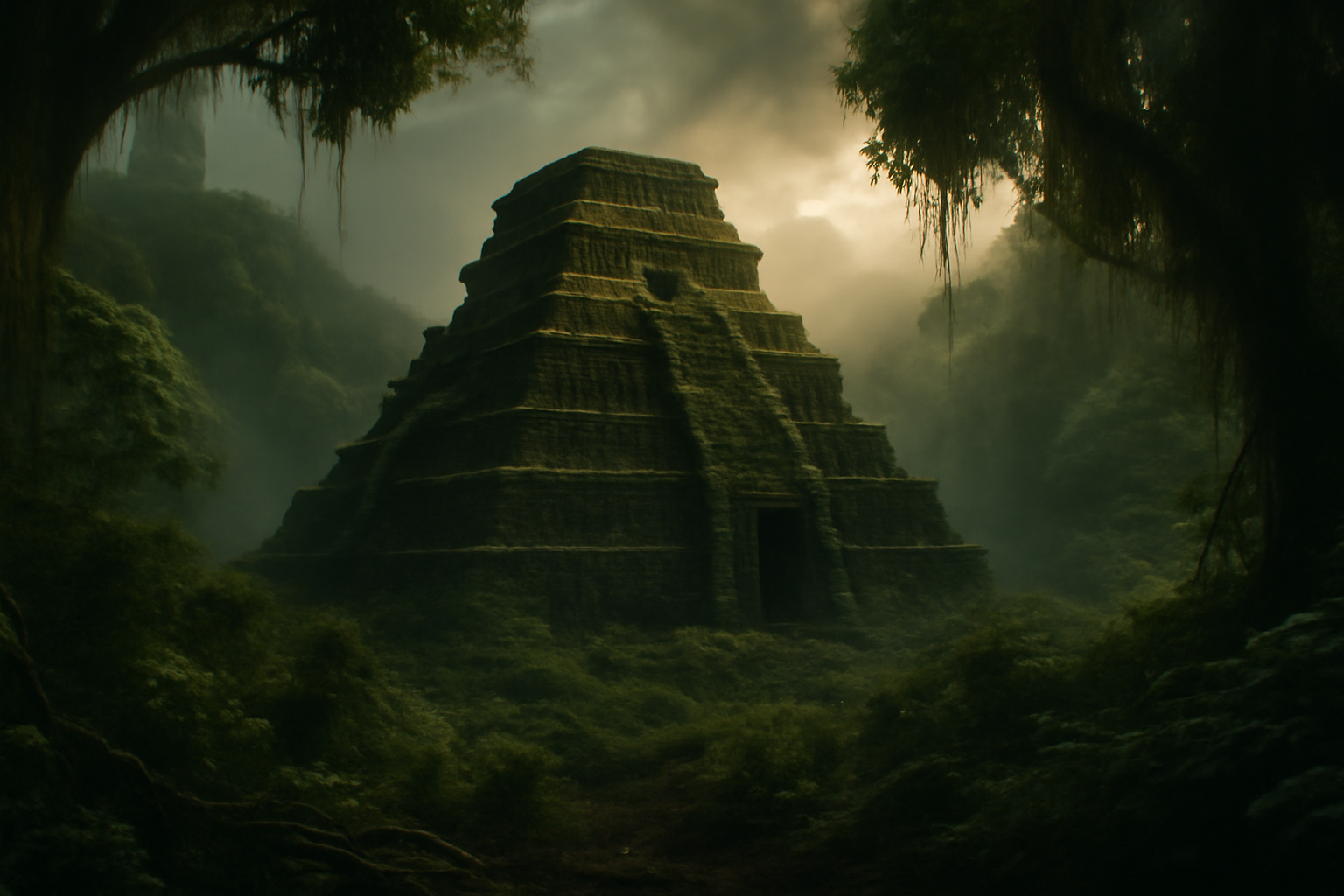
Marcos stared through the glass and saw it: a ziggurat-like temple of pitch-dark stone, squat and ancient, its sides overgrown with vines that were too pale to be normal. They draped the stone like webs spun from dying light.
“What the hell…” whispered one of the botanists.
They landed in a clearing that, according to every map, should not exist. The forest didn’t naturally form perfect circles like this. The trees around it bent slightly inward, as though leaning to stare at the structure.
Marcos stepped out first.
He expected heat and humidity. Instead, the air felt strangely cool, heavy with a sweet, metallic tang—something like orchids mixed with iron.
“Do you smell that?” he asked.
“Yeah,” said Sofia, the geologist. “But I don’t want to.”
The closer they approached, the stranger the vegetation became. Leaves twitched at their passing. Vines contracted slowly, like muscle under skin. A small, moss-covered stone near the base of the structure vibrated, faintly, as if a heartbeat pulsed beneath it.
“Plants don’t do that,” the botanist whispered.
“Nothing here does what it should,” Marcos murmured.
At the base of the temple they found carvings—not of animals, gods, or geometric patterns, but of faces. Thousands of them, worn smooth by time. All open-mouthed. All tilted upward as if frozen mid-scream.
And they were warm to the touch.
By mid-afternoon, the light began to change. It didn’t dim—it thickened. The air took on a golden-brown haze that clung to their clothes. Camera footage would later show nothing unusual, but to the team, it felt as if reality itself had been filmed through gelatin.
That was when they heard the first whisper.
It came from inside the temple—or perhaps beneath it—a sighing murmur that could have been air, or water, or something alive. The sound rose, fell, twisted. For a moment, it almost mimicked speech.
“Anyone get that?” Sofia asked shakily.
“Probably wind,” Marcos lied.
There was no wind.
Inside the first chamber, they found a circular hall scored with long, shallow grooves converging on a central dais. Some grooves were filled with water, others with a thick amber resin that pulsed faintly. The air here was colder still, enough to make their breath fog.
Then Lina, the intern, stopped.
“Did you hear that?”
“Hear what?”
She pointed her flashlight toward the far wall.
The carvings—more screaming faces—were shifting. Slowly, subtly, as if breathing in the reflected glow. Their stone throats vibrated.
“Marcos…” Sofia whispered. “They’re whispering.”
He stepped closer.
The whispering rose again, not quite voices, not quite wind—something in between. It felt like the echo of something that remembered being alive.
When they returned to camp that evening, the clearing had changed.
The trees stood closer. The vines had thickened. The perimeter sensors blared, detecting motion from everywhere and nowhere at once. Every shadow seemed to stretch too far, linger too long.
Something was watching them.
They didn’t sleep that night. The forest murmured and clicked and breathed like a single, living organism. Once, Lina swore she saw a face press out from inside the bark of a tree—straining, mouthing silent words—before sliding back beneath the wood.
In the hours before dawn, Marcos heard footsteps around the tents. Slow. Heavy. Pausing every few seconds. When he finally dared to look out, nothing moved.
But the footsteps continued.
At sunrise, the temple’s stone looked brighter. The carvings deeper. The vines pale as bone. A low hum vibrated through the clearing, shaking the cups on their camp table.
“It’s waking up,” Sofia said.
“No,” Marcos corrected softly, “it’s returning.”
Later that morning, the tribe’s elder arrived—carried by two younger men, both pale with fear. They refused to step into the clearing. The elder pointed a trembling finger at Marcos.
“It was asleep,” he rasped. “Your storm woke it.”
“What is it?” Marcos asked. “A temple? A tomb?”
“A hunger,” the elder whispered.
The vines behind him rustled—not with wind, but with awareness.
“You must go,” the elder said, voice breaking. “The forest is remembering. The old thing inside it is gathering itself. If you stay, it will learn you.”
“Learn us?” Marcos repeated.
“Like clay learns the shape of a hand.”
The ground trembled.
The temple exhaled.
The forest bent inward.
They fled.
By the time they reached the helicopter, the clearing had vanished—the jungle already knitting itself closed, swallowing the temple whole. The last thing Marcos saw before the canopy consumed it was a flicker of pale vines curling upward as if waving.
Or reaching.
Two weeks later, the satellite images updated again.
The bruise-like discoloration had spread for miles. Entire sections of forest were shifting subtly, reorganizing—as if guided by a pattern buried deep in its soil.
Marcos stared at the new images, heart pounding.
The temple had disappeared again.
But whatever had woken inside it…
had not gone back to sleep.